
Searching Clay County Civil Dockets
Clay County puts no civil docket viewer online. There is no daily civil list and no web case-number search either. Every request goes through a clerk's office. Circuit civil files sit with Circuit Court Clerk Keshia Smith, reached at 931-243-2557 or P.O. Box 749, Celina, TN 38551. Chancery files sit with Clerk & Master L. Rene Davis, at 931-243-3145 or P.O. Box 332, Celina, TN 38551. Ask to inspect the docket and how to order a plain or certified copy. Both offices list email and postal contacts. Neither promises that a request can be filed or returned by email, fax, or mail. Confirm the street address before you travel. Official listings show both 100 Court House Square and the county complex at 145 Cordell Hull Drive.
- Choose Circuit, Chancery, or General Sessions based on the case type.
- Give the case style, filing year, number, category, and approximate date.
- Ask for the docket, present status, next setting, and final order if one exists.
- Confirm inspection and delivery options with the record custodian.
- Get the current copy, certification, and mailing total before payment.
Clay Civil Docket Court Split
Circuit and Chancery both hear civil matters, yet each holds its own set of files. General-jurisdiction civil cases belong to Circuit Court. Appeals from lower courts go there too. Chancery takes equity work, along with probate, trusts, domestic cases, and real estate matters. General Sessions holds limited civil jurisdiction. Its exact reach can shift under local law.
| Court | Typical civil work | Custodian |
|---|---|---|
| Circuit Court | Damages, torts, general civil work, and lower-court appeals | Circuit Court Clerk |
| Chancery Court | Probate, trusts, equity, domestic, guardianship, and real estate | Clerk & Master |
| General Sessions | Limited civil claims and detainer matters | Begin with Circuit Court Clerk and confirm custody |
The County Clerk is not the default source for these court dockets. If you are unsure which court fits, describe the filed paper or the relief being sought, and leave out any protected personal details.
Inside a Clay County Civil Docket
Think of a civil docket as an index to acts in the case. It points to papers that often must be ordered separately. So ask the clerk whether the final order is on hand and whether any paper exhibits require an office visit.
| Case reference | Court, division, filing year, case number, and case style. |
|---|---|
| Case category | Such as tort, domestic, probate, trust, real estate, or general civil. |
| Filings | Complaint or petition, answer, motions, and orders entered on the record. |
| Settings | Hearing or trial date, place, and reset information when recorded. |
| Disposition | Settlement, dismissal, transfer, nonjury trial, default, or other result. |
Some attachments stay sealed or come out only in redacted form. A line on the public docket is no promise that financial, minor-related, or protected domestic material is open to view.
Clay Chancery Probate Dockets
Probate and trust work makes Chancery a big piece of Clay County's civil record system. The AOC's fiscal 2024-25 report counted 87 Chancery filings, 53 of them in probate and trust. Chancery also logged conservatorship and guardianship, domestic, real estate, contract, tort, and general civil filings.
Remember, those are reporting counts, not unique cases or people. For a probate request, ask the Clerk & Master directly. Fiduciary accountings or attachments may be sealed, redacted, or available only through a specific inspection process.
Civil Case Types on the Docket
Clay County civil files span several courts and several kinds of relief. Naming the right category helps the clerk pull a docket when no case number is known.
- Damages and tort claims in Circuit Court.
- Miscellaneous general civil matters.
- Probate, trust, guardianship, and conservatorship matters in Chancery.
- Divorce, parenting, support, and other domestic categories where public.
- Real estate, contract, debt, and limited General Sessions matters.
Circuit reported 16 civil filings by count in fiscal 2024-25, led by six damages or tort counts and five miscellaneous general civil counts. Three parenting or support filings and one divorce without a minor also appeared. Those numbers do not mean every related paper is public.
Clay Civil Docket Form Clues
The statewide form set helps decode words on a Clay General Sessions civil docket. It covers payment requests, fee postponement, protection of income and assets, and sworn denial. Tennessee accepts these templates. Local filing steps and cover sheets still need clerk confirmation. The AOC General Sessions civil forms page lists the full set of court-approved forms.
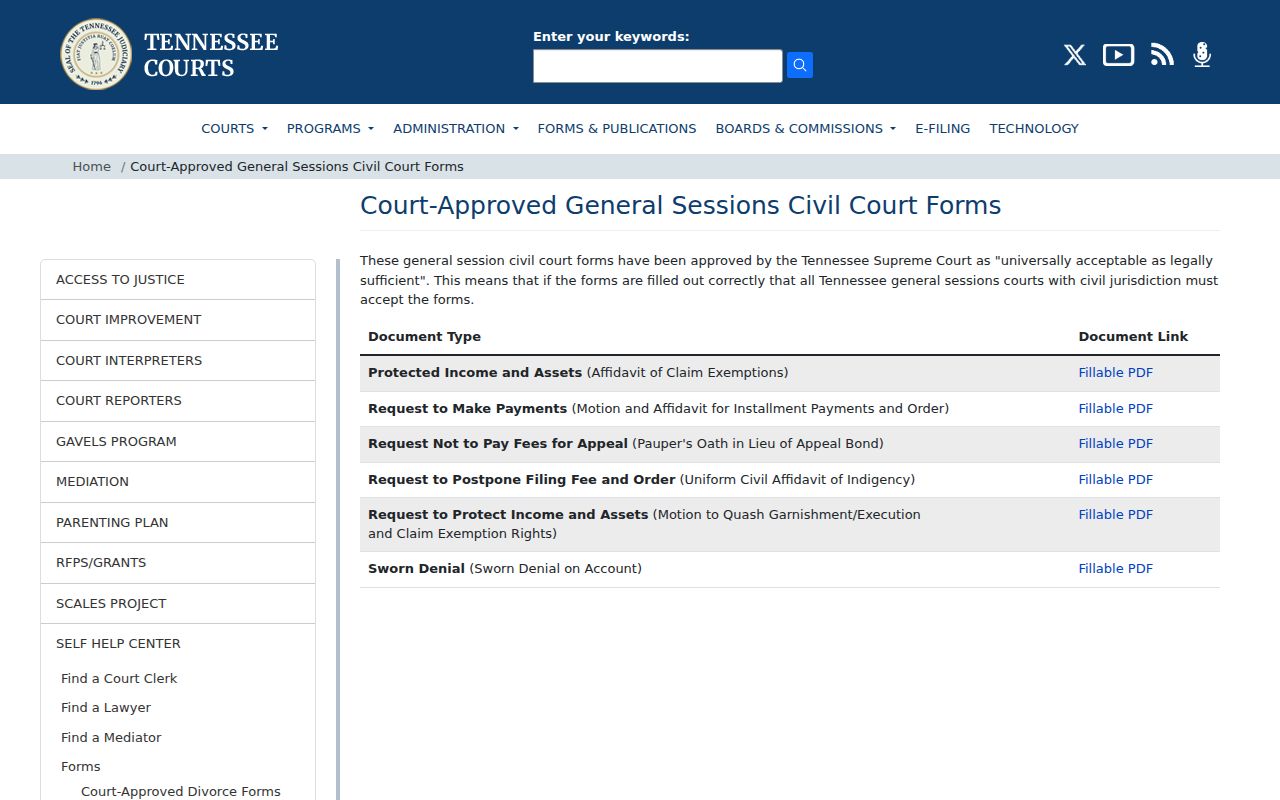
The statewide forms explain common docket terms. They show no live Clay case, no Clay-specific layout, and no filing fee. A detainer form may carry the case number, court date, service return, and reset date. A sample judgment may list default, agreement, dismissal, damages, docket number, time, and courtroom. Borrow those labels to frame a precise records request.
Civil Docket Settings and Hearings
A setting is a scheduled court event, and not always a trial. Ask whether the entry covers a motion, hearing, trial, review, or another step. Ask as well whether it has been reset. Clay clerk pages post office hours rather than a live calendar. The court publishes no daily civil calendar or continuance feed. District 13 local rules set regular Clay county sessions on the third Mondays in April and October. Special sessions are possible. That narrow rule is not a full calendar. Chancery hearing notices under the local rule include the case style, place, date, time, and the party's attendance statement. Confirm the current setting with the clerk. For a wider check, the Clay County court dates resource walks through the date-check process. The clerk remains the source for a changed hearing.
Clay Civil Docket Copy Choices
Inspection, a plain copy, and a certified copy meet three different needs. Rule 34 recognizes inspection of public court records subject to lawful limits. A plain copy reproduces the paper as filed. Certification adds the clerk's official attestation. If a docket line alone will not do, ask for the final order by name.
| Option | What to request | Cost status |
|---|---|---|
| Inspection | Access to the public docket or file at the confirmed office | Confirm procedure and identification rules |
| Plain copy | Named docket sheet, order, or filing | State schedule may apply |
| Certified copy | Named record with clerk certification or seal | Certification charge may apply |
State law effective January 1, 2026 sets 50 cents per page for certain copies and $5 for a certification or seal. Clay posts no local fee sheet, postage chart, or turnaround promise. Call ahead for the exact total and the payment method the clerk accepts.
Civil Docket Access Rules
Tennessee Supreme Court Rule 34 sorts court materials into case, administrative, and judicial records. Access still depends on statutes, court rules, and orders. Sealed files, confidential material, unpublished drafts, and some judicial deliberative records stay closed to routine inspection.
Protected material: Ask whether a redacted copy is available when a public docket references sealed financial data, a minor, an adoption, or a protected address.
Tennessee Public Records Act guidance explains that no central repository holds all public records.
A specific request helps the clerk find a record that already exists. No law forces an office to build a new compilation. Keep your own paper trail: the request date, the channel you used, the clerk response, the exemption cited, the estimate, the invoice, and the delivery record.
Clay Civil Search Without Numbers
No case number? Give the clerk the case style, court type, approximate filing date, and civil category instead. The statewide TnCIS form lets you search by name. Do not assume it reaches Clay. Clay does not appear on the list of participating offices. Ask the clerk to check the index it actually maintains. A spelling difference, an archive, a transfer, or a restricted file can all hide a case that exists. One more pair of tools comes with limits. Public Case History only covers a Tennessee appeal once it enters the appellate system. PACER only handles federal cases.
Note: A no-result search is a reason to double-check the court and the clerk. It is not proof that a civil case never existed.