
Getting Clay County Court Records
Your first step is figuring out which court handled the case. For Circuit Court, the Clay County Circuit Court Clerk is the published contact. That office also routes questions for Criminal Court and General Sessions. Chancery work covers equity, probate, trusts, real estate, and many domestic cases. It belongs to the Clerk and Master. Celina ordinance and city traffic cases start with the City Court Clerk. Confirm the right office for juvenile custody matters before asking for details.
Clay County offers no official online request form, public trial-case lookup, or public terminal. So pick up the phone. Or use the published email or fax, and ask whether the office accepts requests that way. Only mail a request after the clerk confirms who holds the record, who to pay, the total amount, and how copies will be delivered.
- Identify the court and case type.
- Gather the case number, party name, filing year, and document name.
- Call the clerk and confirm the request channel and physical destination.
- Ask whether inspection, a plain copy, or a certified copy meets the need.
- Get a current fee quote before mailing payment.
Clay Court Record Custodians
Tennessee keeps no central repository for every local court file. So in Clay County, custody is the first question. The county clerk issues county licenses and keeps other county records. It does not hold court files by default. The Circuit Court Clerk and the Clerk and Master each hold different case groups. The Celina City Court Clerk handles municipal matters.
| Record sought | First contact | Verification step |
|---|---|---|
| Circuit civil, criminal, or General Sessions | Circuit Court Clerk | Confirm the exact court file |
| Chancery, probate, trust, or equity | Clerk and Master | Ask about public access limits |
| Juvenile | Clerk and Master or directed clerk | Confirm eligibility before requesting |
| Celina ordinance or city traffic | City Court Clerk | Ask whether the matter transferred |
| Tennessee appeal | Appellate clerk | Use Public Case History only after appeal |
Court Record Types
A case record is the material inside the official file for one case. It can include the docket, pleadings, motions, notices, orders, judgments, and public exhibits. Separate from that, administrative records deal with how the court itself runs, and judicial records cover other papers a judge creates in an official role. Tennessee Rule 34 treats these as distinct groups with different exclusions.
- Docket sheets and chronological event entries
- Complaints, petitions, answers, and motions
- Hearing notices and filed service records
- Signed orders, judgments, and dispositions
- Public exhibits and attachments that are not sealed
Transcripts are not automatic parts of every file. Clay County posts no court-reporter contact or transcript-order process. Ask the clerk whether the hearing was recorded, and whether the clerk or a reporter can supply the item.
Clay Offices Use Two Addresses
Clay County offices use two different addresses. Mixing them up will send you to the wrong door. The AOC courthouse listing lists 100 Court House Square for Clay County Circuit, Criminal, and Chancery Courts. County office pages, meanwhile, use 145 Cordell Hull Drive for the county complex and clerk contact addresses. Treat them as two separate destinations, not one.
Before traveling: ask which building and office holds the file, whether an appointment or identification is needed, and whether inspection is available that day.
Don't treat published office hours as proof of records-room hours or hearing times. The Circuit Court Clerk lists weekdays from 8 a.m. to 4 p.m. The Clerk and Master keeps those hours Monday, Tuesday, Thursday, and Friday, with Wednesday hours from 8 to 11:30 a.m.
Inside a Clay County Court Record
What sits inside a file depends on the court and the type of case. A docket is just an index of events; the full file holds the underlying public documents. State forms suggest common fields, but they do not prove Clay County uses one fixed local layout.
| Case number | The clerk's identifier, often paired with the filing year and court. |
|---|---|
| Case style | The official caption naming the parties and matter. |
| Docket entries | Dated filing, setting, order, and disposition events. |
| Pleadings | Complaints, petitions, answers, motions, and responses. |
| Orders and judgment | Signed rulings and the recorded outcome when public. |
| Service record | Issue, service, return, and related officer entries when filed. |
For a precise request, name the document and its date if known. Broad wording may not match an existing record, and no custodian has to build a new compilation for you.
Clay Court Records Online Limits
Clay County dockets face a real limit online. The TnCIS public search landing page offers a statewide inquiry route for participating offices. But the office selector does not list Clay County. That gap does not mean Clay case records are uncomputerized. It only means the Clay clerk has not joined this particular court docket search service.
For the current list of participating offices, check the official TnCIS source. Do that before relying on it for a docket lookup.
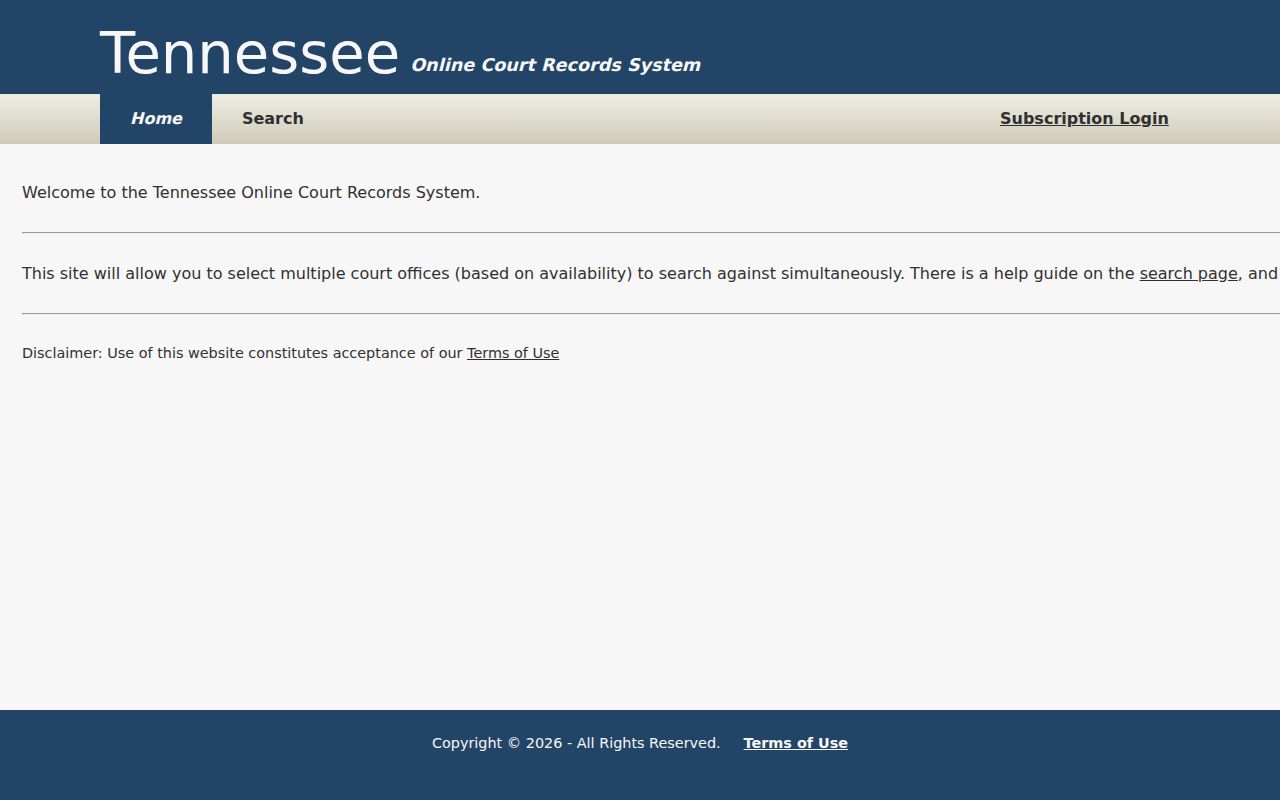
The statewide screen can change over time. If Clay County still is not listed, work through the clerk routing chain instead. A blank or unavailable search is not evidence that no case exists.
Tennessee's Public Case History works differently. It covers appellate cases and, where available, linked appellate documents. It will not search Clay County trial files. That changes only if a matter has reached an appellate court.
Clay Records and Electronic Filing
Electronic filing and public viewing are separate services. Tennessee Rule 5B sets a framework for filing electronic documents, but Clay County publishes no local e-filing rules or public viewer. A filing channel for parties and lawyers is not public access to the court record. The Tennessee trial-court e-filing page explains the statewide setup.
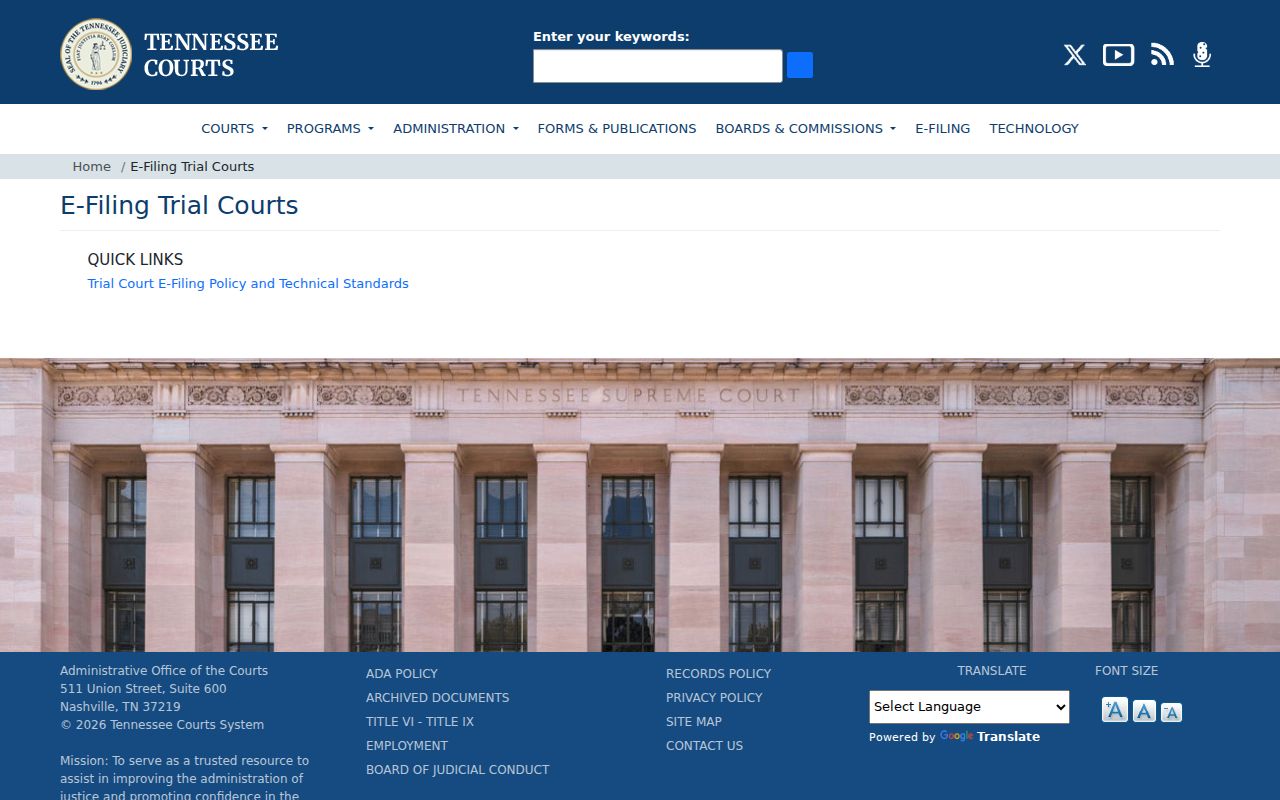
That state page gives context only. The Clay clerk remains the authority on whether a particular document can be inspected or copied. The county offers no bulk download, API, subscription, kiosk, or vendor access route.
Fees and Certified Copies
A plain copy just reproduces a public document. A certified copy carries the clerk's certification or seal, which is what you want when an official copy is required. The statewide schedule is not a Clay-specific quote. Ask the clerk to confirm the charge for your item and whether postage, media, or other costs get added.
| Statewide reference | Published amount |
|---|---|
| Copy of a document other than an original filing or appellate record | $0.50 per page |
| Certification, seal, or specified certified record | $5 |
| Post-judgment fee | $25 |
| Reopen a closed case | $75 |
| Computer search with commercial value | $7 |
| Fax service under Rule 5A.04 | $5 plus $1 per page |
The cited changes come from the Tennessee General Assembly and take effect January 1, 2026. Clay County publishes no fee sheet, copy-order form, payment-method list, or turnaround promise, so get the numbers from the clerk.
Clay Court Record Request Details
Write down when you made your Clay County request. Note how you sent it and who answered. Record any fee estimate and how the copies will reach you. Need more than one case file? List every case number separately. One more tip: call before faxing or emailing. A posted address alone does not prove the clerk accepts that channel.
Circuit Court Clerk Keshia Smith
P.O. Box 749, Celina, TN 38551
931-243-2557
keshia.smith@tncourts.gov
Clerk and Master L. Rene Davis
P.O. Box 332, Celina, TN 38551
931-243-3145
rene.davis@tncourts.gov
Local official sites give different fax numbers. A quick phone call to the clerk settles it. For the wider search picture, the Clay County case lookup shows why statewide tools often miss local trial court records.
Sealed Records and Public Access
Tennessee Supreme Court Rule 34 opens most court records to the public, but it still honors limits set by statute, by rule, or by a judge's order in a Clay County case.
The Rule 34 page spells this out.
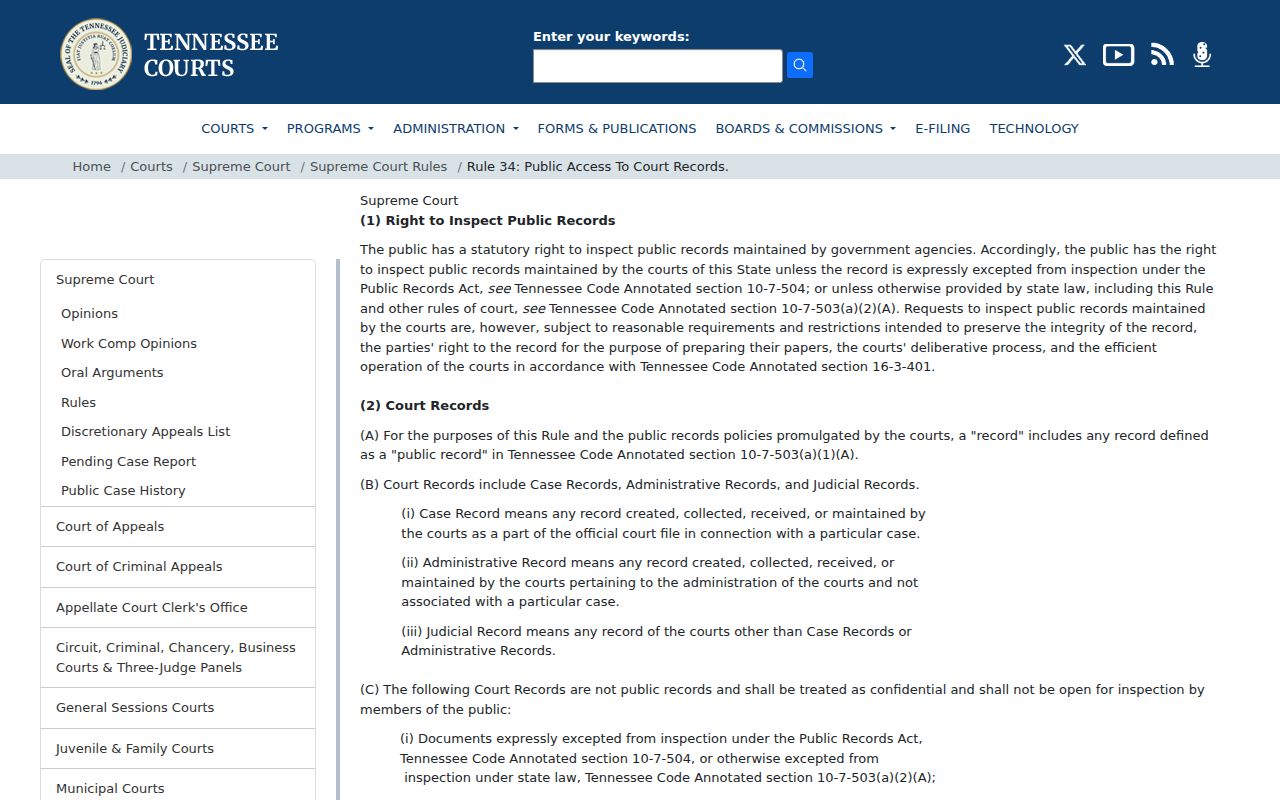
Not everything lands in public view. The rule keeps sealed material, unpublished drafts, working copies, deliberative records, and confidential information out of reach. So a public Clay County docket entry does not expose every exhibit or personal detail.
Access boundary: juvenile, adoption, treatment, protected-address, and sealed materials may be withheld or redacted. Ask the custodian whether a public version is available.
Tennessee Public Records Act guidance says requests go to the office believed to hold the record. If access is denied, T.C.A. §10-7-505 provides a petition route in the relevant Circuit or Chancery Court.
Sealed and expunged are different things. A sealed file stays restricted under legal authority, while expungement requires its own order and statutory process in the court where the case began. And an empty online result proves neither one.